Acids Summary of Findings
Overview
As acids and bases is a broad topic, to narrow our focus we limited our search to videos that addressed the conceptual understanding for why compounds act as an acid (or a base if it also talked about acids), including both Bronstead-Lowry and Lewis Acids. The following search terms were used to identify videos for consideration:
- Bronsted Lowry acids and bases
- strong vs weak acids
- acid and base conceptually
- What is an acid?
- strong acids and bases
- Acids and bases explained
- What are acids and bases?
- Acid and Base Chemistry
- What makes an acid an acid
- acid and base reactions
These search terms resulted in 56 videos that were in English and were of appropriate length. Eleven of these videos clearly did not meet the broad topic of interest on a first pass viewing. Given the large number of videos, we maintained an expectation that videos must have 100,000 views. This resulted in 34 videos to review. We added two videos that had fewer than 100,000 views because they were part of a four- part series, resulting in 36 videos that were analyzed. During our deeper analysis it was determined that 11 of the videos did not actually address the topic of interest, but instead focused solely on identifying acids or bases in chemical reactions or predicting products of acid/base reactions. The following information is based on the remaining 25 videos which were coded using the framework by two faculty and six undergraduate research assistants. The Framework looks for the presence of Johnstone’s Triangle, 3D learning elements, multimedia principles, and accessibility elements. After evaluation of the videos, we found that few videos addressed the ideas of what causes acids to react or causes acids to dissociate in water. We revisited videos from our initial searches with fewer than 100,000 views to see if we could find videos that specifically addressed these gaps. However, we were unable to find videos to address these gaps.
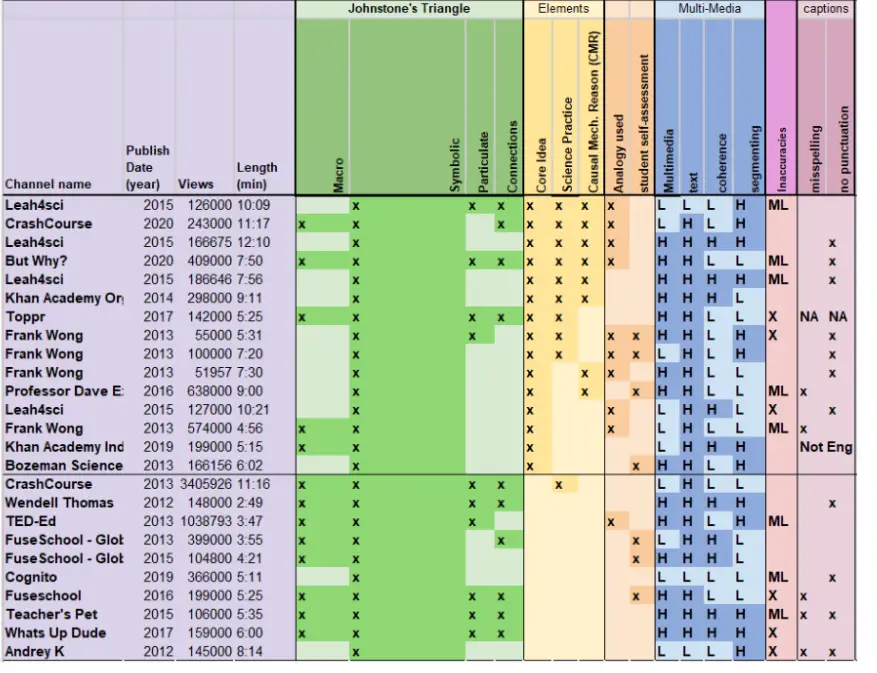
Patterns
General
We noted a few general observations during our coding. If an explicit definition of an acid was used, it was overwhelmingly the Bronsted Lowry definition, with few (2/25) videos also addressing the Arrhenius or (a different 2/25) the Lewis definitions. Further, though many of the videos (16/25 or 64%) addressed the concept of strong and weak acids, or what made an acid stronger/weaker, no video explicitly addressed what made something acidic.
Johnstone's Triangle
Consistent with other topics, symbolic representations were present in all videos. Macroscopic (13/25 or 52%) and particulate (10/25 or 40%) representations were used less frequently in the videos. These values are in the middle of other topics for macroscopic and particulate representations representations. For macroscopic other topics ranged from 18% (bonding) to 71% (gases), with an average of 51% across all topics coded and particulate ranged from 16% (LCP) to 79% (gases) with an average of 47%. One explanation for fewer than half of the videos having macroscopic examples is that unlike with gases where you can clearly show how the volume of a gas changes with temperature or pressure, with acids there is less value you get out of watching someone pour vinegar into water and watching a color change. Another interesting note about the macroscopic examples for this topic is that there were a few videos that only included a verbal description of a macroscopic example (for example talking about vinegar or lemon juice but not visually showing it). This was not something we saw frequently with the other topics. It is also important to note that most videos showed acid molecules in some form (ball and stick, Lewis structure) but they largely focused on just one molecule. For example showing the loss of the acidic hydrogen atom for one molecule or HCl or benzoic acid. We coded these elements as symbolic but not particulate. To be coded as particulate, the video had to show acid and base molecules interacting or acid molecules interacting with water molecules as they dissolved. Additionally, there was a disconnect between the presence of multiple elements of Johnstone’s Triangle and the inclusion of Core Ideas, Causal Mechanistic Reasoning (CMR), or science practices. Videos that had more than one element of Johnstone’s Triangle present, particularly if there was an explicit connection made between the levels, often did not have any 3D learning elements present.
3D Learning Elements
Within the videos on acids, Core Ideas (CI), Science Practices (SP), and Causal Mechanistic Reasoning (CMR) were reasonably common, with 15 of the 25 acid-base videos (60%) containing a CI, 10 having an SP (40%) and 8 having CMR (32%).
The most prevalent Core Idea was Atomic and Molecular Structure and Properties (11 videos). Videos that contained this core idea had to address how the structural features of a molecule impacts its relative strength as an acid (or base). For example, describing how resonance structures or the inductive effect can stabilize the anion on a conjugate base resulting in a stronger acid. Fewer videos covered the CI of Change and Stability (3 videos). These videos addressed how acids or bases dissociate in water and relate that to the stability of the particles. Only one video addressed Electrostatic Bonding and Interactions. To meet this CI, the video needed to indicate how acids and bases react with a focus on their polar and electrostatic interactions.
Ten of the acid/base videos included a Science Practice (40%), with most of those (7/10) were coded for Constructing Explanations. Notably, all but one of the videos coded for a SP also contained a CI. The one video with a Science Practice but without a Core Idea had a relatively weak example of a SP as it just referenced the effects of acid rain on a statue throughout the video. This seemed to be because the phenomenon was primarily included to keep the attention of the viewer and entertain instead of being intended to address deeper conceptual understanding.
Eight videos contained CMR (32%). To be coded as having CMR, a video needed to answer the question “What causes acids to react?” They then needed to indicate that the acids donate an H+ ion (or form a stable anion). Lastly, to address why this happens, the videos needed to address that the acidic H+ atoms are bonded to highly electronegative atoms and that when the acidic H is donated that a relatively stable ion is formed through favorable interactions with water. Alternatively, videos could have answered the question “What makes a substance more or less acidic?” They then needed to explain that molecules that form more stable conjugate bases (anions) when dissociated in water are stronger acids. This is because the anions can delocalize the negative charge by having the negative charge on larger electronegative atoms (eg. Cl-) or through inductive or resonance effects.
Each video coded for CMR was also identified as containing a CI and 6/8 also had a SP. Seven of the eight CMR videos addressed the “What makes a substance more or less acidic?” question while only one video addressed what causes acids to react.
Overall, we noted that seven videos used organic molecules as examples to discuss acids, most represented by line drawings. These may not be appropriate for all general chemistry courses. However, five of these seven videos were also coded for CMR. This may be because organic molecules may provide better examples of resonance or the inductive effect, so these structures allowed for a deeper explanation with more conceptual understanding. Further, videos presupposing knowledge about organic chemistry structures may suggest a different set of expectations for the viewer. This could be because the video is intended to support a more advanced chemistry class (such as organic). However, it does highlight how organic structures can be used to support understanding that involves CMR.
Multimedia Patterns
Overall, the acid/base videos effectively incorporated many of Mayer’s Multimedia principles. Compared to previous topics we have coded (Gas Laws, IMFs, Bonding, and Le Chatelier’s Principle), acid/base videos had the highest percentage of videos with minimal text on screen (88%). This is different from previous topics which ranged from 60% (LCP) to 82% (bonding) of videos with minimal text on screen. Though still low at 40%, more videos had high coherence for acids than for other topics which ranged from 13% (Enthalpy) to 28% (LCP). Videos evaluated as high coherence contained content relevant to the topic and learning and exclude extraneous content such as music, unhelpful graphics/animations, background changes, sounds, or anything else that distracts from the content of the video. Most videos that were coded low for coherence had an instructor present talking on the screen or background music throughout the video. 60% of acid/base videos contained meaningful and relevant images that support the conceptual understanding of acids and bases and 52% of acid/base videos had high segmenting, both of which are consistent with previous topics (overall average of 61% high for images and 57% high for segmenting across all topics coded). Videos that scored low for images were largely ones that primarily had the instructor talking or ones that just used chemical equations and no additional images. While we did not consider things like HNO3 or H2SO4 as images, we did consider skeletal structures of things such as acetic or benzoic acid to be images as these could be used to show where the acidic hydrogen was and were frequently used along with arrows to show movement of electrons in dissociation of acids. Videos evaluated as high for segmenting contain elements that meaningfully support student organizing content or identify key ideas such as an introductory organizer, headings, or a summary that wraps up the video. Videos that scored low for segmenting were ones that addressed multiple ideas but did not have an introduction, summary, or any way of meaningfully partitioning the video into pieces that would help learners organize and process the content.
Content Accuracy and Accessibility Patterns
Captions are a critical feature used by many viewers. Captioning is considered because a learner may need to rely on the captions to understand the conceptual topic, and a lack of capitalization, punctuation, and accurate spelling can hinder full understanding. All but two of the videos had English captions, with 11 (44%) of the videos relying on YouTube’s automatic caption feature. This automatic caption feature lacks correct capitalization, punctuation, and will misspell some scientific as well as common terms. Three videos that did not rely on automatic captions included misspellings.
Analogies in videos can be used to simplify and assist conceptual understanding. In these 25 acid videos, 10 (40%) of the videos used analogies, and all but one of these videos included a CI. Analogies were primarily used in videos to help visualize resonance or charge stabilization on a compound and its relation to the strength of acids and bases, which directly relates to the Atomic/Molecular Structure and Properties CI. A common analogy for this concept liken charge on a compound being shared between certain atoms to two friends sharing the load of lifting a heavy object. This is notably higher than other coded topics that range from 13% (enthalpy) to 28% (Le Chatelier’s Principle) in their use of analogies. However, in previous topics there was no correlation between analogy presence and if a video contained a conceptual element.
In terms of inaccuracies, 24% of acid videos contained a content inaccuracy and 32% of acid videos had a misleading element. This level of error is fairly consistent with what has been noted for most other previously coded topics. The most common inaccuracies for acid videos revolved around incorrect drawings of compounds, molecular formulas, or chemical equations. An example is hydrochloric acid being represented as HCl+ or a chemical equation not including water and thus not being balanced. Other inaccuracies address conceptual elements more directly, such as acidic hydrogens or a conjugate acid pair’s strength being mislabeled. Acid videos with misleading elements included personification of atoms and molecules by drawing them with facial expressions or assigning emotions to them. This misleading element was found in previous topic videos as well, but it was more common in acid video.