Atomic Radii Summary of Findings
Overview
To explore the topic of atomic radii, we were searching for videos that emphasized conceptual understanding of atomic radius or ionic radii, including how atomic radius changes across a period or down a group on the periodic table. A complete explanation for the trends typically involved effective nuclear charge (Zeff) and Coulomb’s Law, though these topics did not have to be included in a video to be part of our data set. We did not focus on videos that just gave a description of the trend or memorization tricks without an attempted explanation for the underlying reason for the trend itself. We used the search terms below to locate videos that were potentially relevant to the periodic trend of atomic radii and ionic radii.
- Periodic trends
- What are periodic trends?
- Atomic radius, Coulomb’s Law
- Explanation of atomic radii trends and examples
- Why does the size of an atom increase as you go down a family in the periodic table?
- Atom size and periodic table
- Ionic radii
- How do periodic trends affect atomic radius?
- Atomic and ionic radius
- Atomic radius, periodic trend
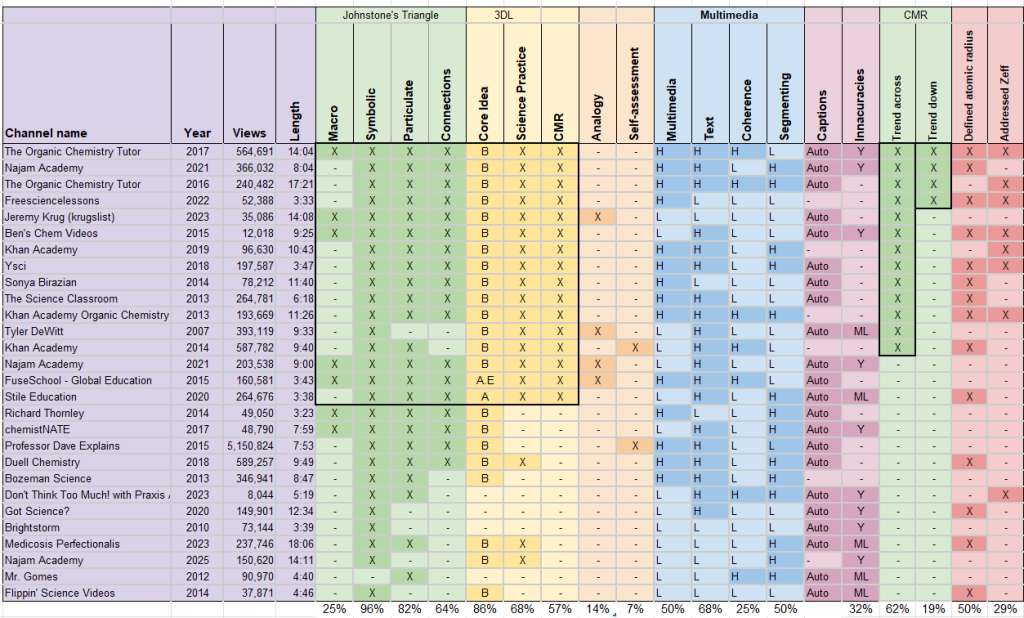
Our initial search yielded 81 potential videos that were in English, focused on education, roughly 15 minutes or less, and could meet our concept of interest. Focusing on videos with more than 100,000 views, yielded 30 videos. Through the coding process, 13 videos were identified as not meeting our concept of interest due to their lack of conceptual focus. As we generally aim for a larger set of videos, we dropped the cutoff to 30,000 views to add in 16 potential videos, of which 7 were excluded due to lack of conceptual content. Two lower view count videos were also coded. In total, we ended up with a final data set of 28 videos that were coded individually by 1 faculty member and 3 undergraduate research assistants; the consensus coding results are summarized in the table below.
Patterns
General
During the coding process, several observations regarding how atomic radius was presented jumped out to us. First, videos tended to provide more depth of explanatory reasoning for the trend of decreasing across the periodic table compared to down a group. Second, only half of the videos (14/28) provided a meaningful explanation defining atomic radius, with the other half assuming that size was self-explanatory.
Johnstone's Triangle
Similar to what we have seen with previous chemistry topics, symbolic representations were highly prevalent in atomic radius videos. Nearly all of the videos (27/28, 96%) analyzed incorporated symbolic representations with the periodic table being a key symbolic representation. Most videos also included particulate representations (23/28, 82%). This is the highest percentage observed so far across topics coded to date. This likely reflects the importance of visualizing atomic structure when explaining periodic trends with the most common representation being a Bohr model of atoms or similar atomic diagrams to illustrate the changes in atomic radius across periods or down groups. These visualizations allow viewers to visualize differences in electron shells, electrons shielding, and attractive forces between the nucleus and the surrounding electrons. Such particulate representations were often connected effectively to symbolic representations. By providing a clear depiction of atomic structure, particulate representations can support deeper conceptual understanding and help connect atomic radius trends to the underlying mechanisms that helped support that learning.
In contrast, relatively few (7/28 or 25%) videos included macroscopic representations. This could have been due to the abstract nature of atomic radius and the limited examples of real-world phenomena that illustrate atomic size. Generally any videos with macroscopic examples provided specific measured sizes of atomic radii to demonstrate the trends.
3D Learning Elements
Atomic/Molecular Structure & Properties was only present in 2/28 (7%) of the videos (labelled with an A in the summary table). Videos coded for this CI connected variations in atomic radius to chemical reactivity. An example of this would be an instructor explaining greater reactivity of alkali metals further down the periodic table. This concept was rarely observed as most videos primarily focused on just the trends rather than their implications.
Science practices (SP) were particularly high for this topic (19/28 videos, 68%). In many topics previously explored, videos close to science practices frequently were missing the observation or phenomenon. However, the atomic radii trend itself provided a phenomenon, thus any strong explanation (including any video with Causal Mechanistic Reasoning (CMR)) was likely to at least meet the criteria Constructing Explanations, the most commonly observed SP for this topic (11/28 videos,39%). Developing and Using Models (9/28 videos, 32%) was the next most common, frequently the Bohr model was used to explain how atomic radius varies with the addition or removal of more electrons, protons, or electron shells. Two other Science Practices were observed much less frequently. Three videos (11%) demonstrated the SP of Analyzing and Interpreting Data by providing the audience with atomic radius measurements and then interpreting them in the context of the differences between elements. Using Mathematics and Computational Thinking was present in just 1 video (4%) where they used Coulomb’s Law to explain how changes to the number of protons would impact the attractive forces and thus the size.
Causal Mechanistic Reasoning (CMR) was present in 16/28 videos (57%). Compared to other topics, this is high. CMR required videos to explain both the how and why behind a specific relationship, with many videos including multiple CMR level explanations for different observations. Most frequently videos explained how atoms get smaller as we go across the periodic table (13/28, 46%), whereas only 4/28 videos (14%) explained why atoms get larger down the table at that same level of depth. Many fewer videos address ionic radii and only 4/28 videos (14%) addressed why cations were smaller than their neutral atoms and 2/28 (7%) videos addressed why anions are bigger than their neutral atoms. Lastly, 2/28 (7%) addressed the effect of atomic radius on chemical reactivity.
The difference in prevalence of CMR for explaining the trend across vs. down the period was striking. This appears to be due to its counterintuitive nature for the trend across the periodic table; most new learners may assume that more protons/electrons (or “stuff”) being added means a bigger atom which then requires a more in depth explanation. For down the table, videos seemed to rely on appealing to the audience’s common sense (i.e. more shells = bigger) rather than providing a full CMR level explanation that addresses changes in shells, protons, attractive forces, and electron shielding. The issue with this surface level explanation was highlighted in one video that directly compared the atomic radii of Be (111 pm) with electron configuration of 1s22s2 and P (110 pm) and an electron configuration of 1s22s22p63s23p3. Clearly, P has more electron shells, but it has a slightly smaller atomic radius than Be due to the greater effective nuclear charge of P.
Multimedia Patterns
Although videos that scored high on 3 or 4 of the multimedia criteria may be slightly better in terms of content, there were no strong trends observed.
Content Accuracy and Accessibility Patterns
Of the 28 analyzed Atomic Radius videos, 9 (32%) contained scientific inaccuracy, while 5 (18%) contained misleading statements. In general, we noted fewer videos with errors or misleading statements when CMR was present (25 vs 42% errors and 6% vs. 33% misleading). This might suggest that videos with greater depth came from creators with stronger knowledge or care in wording. There was no single common inaccuracy that spanned multiple videos, though issues were most common around the ideas of Zeff or shielding. Several inaccuracies were a misalignment between what the narrator said and what was on the screen, often appearing to be a mis-speak on the part of the narrator or broad generalizations (e.g. stating that atoms with a larger Zeff will be smaller, without acknowledging that number of shells also play a role). Misleading statements most commonly arose from heavy personification when describing atomic behavior, which could encourage learners to attribute intentional actions to atoms. Videos were not coded as misleading if they had only an occasional moment of personification. Only 6/28 (21%) of videos had no issues with captions with most videos relying on autocaptions, which sometimes contained misspelled scientific terminology or lacked proper punctuation, reducing accessibility for viewers who depend on captions.