Bonding Video Analysis Summary of Findings
Overview
Bonding was the general chemistry concept focused on following Le Chatelier’s Principle. Using our general search process we found 49 videos that met our broad criteria including time length, language, educational focus, and stand-alone nature (not supplement to a classroom activity). The videos were coded by two faculty members and two undergraduate students. After which, all coders met to come to a consensus on the coding for each video. After conducting an initial analysis of these videos we culled the number to 28 videos for detailed analysis by multiple raters. The final agreed-upon ratings of the videos are summarized in the table below.
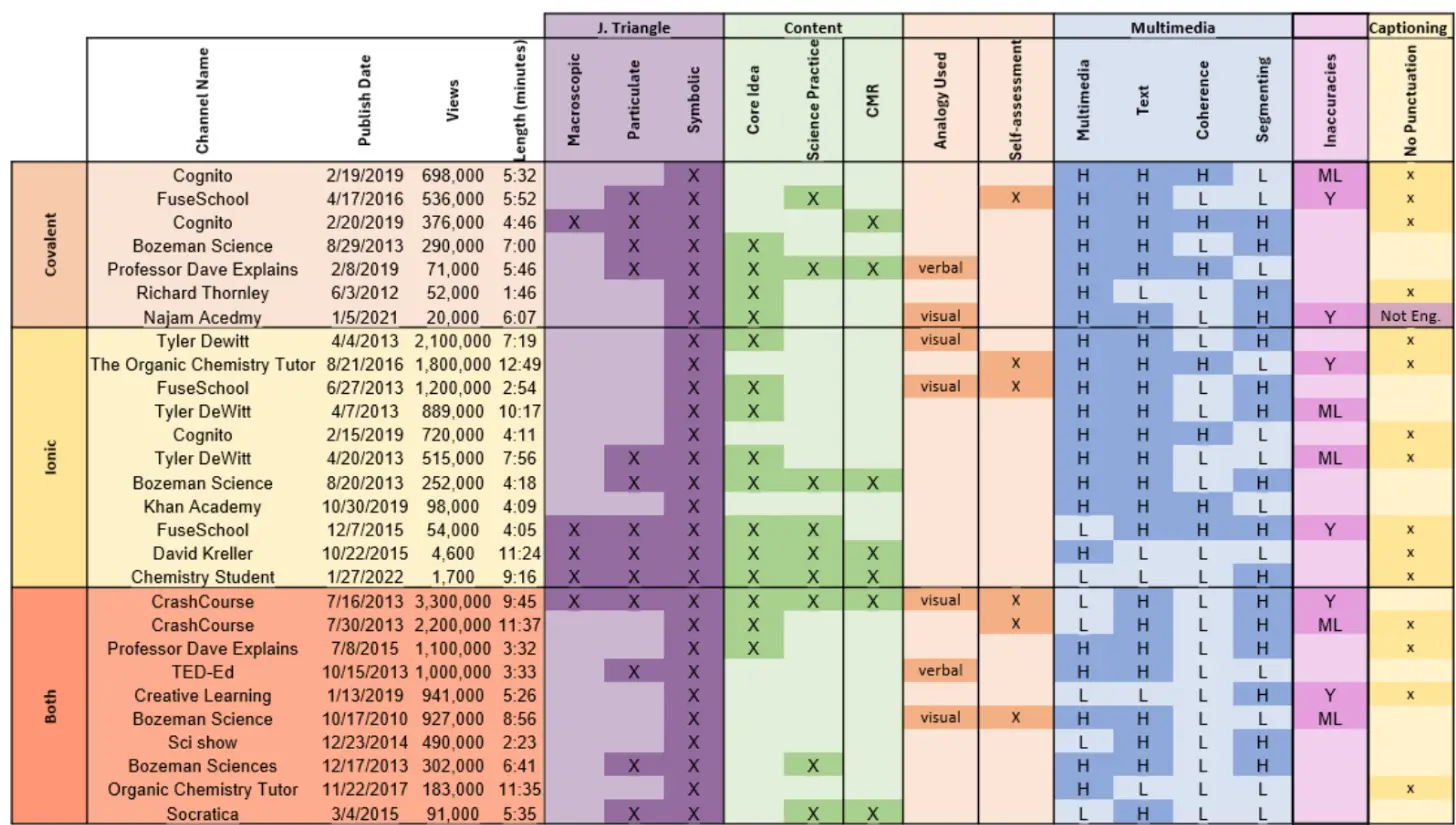
Table 1: Summary of video coding for bonding videos. Videos are separated by content if they discuss only covalent bonding (top set of videos), ionic bonding (middle set), or both (lower set). Some channels have multiple relevant videos. Analogies column indicates if the analogy is verbal only (verbal) or both visual and verbal (visual). The inaccuracies column indicates if an inaccuracy was present (Y) or if it was misleading (ML).
Patterns
Most Common Elements
Based on these data, we noted the following patterns. Symbolic representations (Johnstone’s Triangle) were present in all 28 videos coded. This may be because bonding is most frequently separated into ionic and covalent bonding and we typically use chemical formulas to identify whether a substance is ionic or molecular. As noted in Table 1, we found that some videos focused on just covalent bonding, some on just ionic bonding, and some on both types of bonding.
Least Common Elements
We found that Causal Mechanistic Reasoning (CMR) and Macroscopic representations (Johnstone’s Triangle) were the criteria least frequently included in the videos we analyzed. For Macroscopic, we only considered a video to include a macroscopic representation if it gave a specific example (e.g., the mp of NaCl is 801 ℃ compared to sugar which has a mp of 186 ℃) or if it explicitly connected macroscopic images (e.g., solid salt crystals and glass of liquid water) to the type of bonding. If a video just indicated that ionic compounds tended to have higher melting points or if it showed macroscopic images without explicitly connecting those to the type of bonding, we did not code this as Macroscopic.
For videos that contained CMR, we found that they were answering one of the following questions:
- What drives the formation of bonds between atoms?
- What determines the relative strength of ionic bonds?
- What is the relationship between different types of bonds and physical properties?
Of the seven videos that contained CMR, two answered question 1, four question 2, and one question 3. Many videos were found to partially but not fully address question 1. For example, instructors often define covalent bonds as an attraction between oppositely charged particles but do not indicate that these attractions form to lower the potential energy of two non-interacting atoms.
3D Learning Elements
Regarding 3D Learning elements, we noted that Core Ideas were coded more frequently for videos discussing only ionic bonding as opposed to those that discussed just covalent bonding or both ionic and covalent bonding. This stemmed from a key element of Core Idea for electrostatic bonding and interactions being that bonds form from the electrostatic attraction between oppositely charged elements (e.g., ions or protons of one atom and the electrons of another). In describing ionic bonding videos typically described ionic bonding as the attraction between oppositely charged ions; however, for covalent bonding videos frequently described it as the “sharing of electrons” with no mention of electrostatic attraction. Although we focused primarily on identifying if a Core Idea was present and not which one, we noted that most videos including a Core Idea tended to address Electrostatic Bonding and Interactions. Only four addressed Energy and three Atomic/Molecular Structure and Properties. Fewer videos were found to include Science Practices than Core Ideas. Again, though we were focused primarily on identifying the presence of Science Practices, Developing and Using Models was the practice included most frequently with Analyzing Data and Constructing Explanations and Engaging in Argument from Evidence also being present in multiple videos.
Our initial threshold for inclusion of video for initial screening was >300,00 views for bonding. This is notable, as the bonding has far more highly watched videos (suggesting it is a more sought-after topic) than Le Chatelier’s Principle. Additional videos were included if they appeared as highly relevant according to the YouTube search algorithm and on a first pass seemed likely to have a Core Idea, Science Practice, or CMR (evidence that they focused on conceptual understanding rather than simply skill development). We found even when using more selective search terms aimed at identifying videos focused on conceptual understanding as opposed to skill development (e.g., why do atoms form chemical bonds?; bonding, energy, stability; or covalent bonding, electrostatic attraction) we turned up videos near the top of the list that were solely focused on things like drawing Lewis Structures. Such skill-focused videos were not included in our final video set for analysis.
Content Accuracy and Accessibility Patterns
In this context of video selection, we observed that the highly viewed videos tended to have more misleading/incorrect information. This should, however, be interpreted in the context of our video selection process. Less-viewed videos with notable incorrect or misleading information would likely have been screened out of the final data set. It should be noted that the main reason a video was coded as containing misleading information was a heavy use of anthropomorphization, giving atoms agency such as atoms“wanting” an electron, atoms being “happy” with an octet, etc. Videos were not flagged as containing misleading information for just one small instance of this, only if it was strongly built into the explanation of the content. This was the most common issue and is considered problematic as heavy reliance on anthropomorphization detracts from developing an accurate understanding of the energetic driving force behind bonding. The second most common issue observed was inaccurate depictions of atomic or molecular structures. Notably, the inclusion of misleading or incorrect information in many of the highly viewed videos is concerning. The popularity of videos despite having misleading/incorrect information may stem from viewers gravitating to more entertaining videos or it may be a reflection of novice learners not yet having the background knowledge to effectively identify errors or misleading information.
Multimedia Patterns
In considering Mayer’s Multimedia principles, the reduction of extraneous cognitive load was the greatest challenge as the principle of Coherence was most frequently violated. This was particularly true for many of the more “commercial” videos where the goal may have been to try and combine entertainment with education. Many of these videos included distracting elements such as flashing transitions, background music, inclusion of side-topics that were related to the content but not relevant to learning the concept, and the image of the presenter on-screen consistently throughout the video. A Multimedia strength was certainly the ability to help foster generative processing as most videos used high-quality relevant images. They also minimized the use of text on the screen which was a beneficial way that they decreased extraneous cognitive load. Interestingly, the ability to manage essential processing through Segmenting was lower for the topic of bonding than it was for LeChatelier’s Principle. We also noted that overall the quality of captioning for most videos was either very good or just lacking in punctuation. Generally, the correct spelling of scientific terms was not a problem.