Buffers Summary of Findings
Overview
In general, we found it more difficult to identify videos that met our concept of interest than for other topics. Of the 21 videos we found and coded in detail, almost half (10/21) had fewer than 100,000 views. We were focused on coding videos that addressed the conceptual understanding of buffer systems. This includes how buffers are formed, how buffers work, what limits the capacity of buffers, and why buffers are useful. We did not include videos that exclusively solve mathematical problems involving buffers without addressing the conceptual aspects. In particular, we determined that videos that only used the Henerdson-Hasselbach equation to solve buffer problem without addressing the equilibrium nature of the buffer system would not be considered as meeting our concept of interest. An initial search for videos was conducted by five undergraduate students and two faculty members using the search terms below:
- Buffer solutions
- What is a buffer?
- Buffer in chemistry
- Buffer explained
- How do buffers work?
- Components of a buffer
- Buffer capacity
- Buffer examples
- pH resistance in buffers
- Buffer systems
This initial search yielded 16 videos that were in English, under 15 min in length, and had over 100,000 views. Detailed coding of these videos identified seven of these videos as not meeting our concept of interest or not having a conceptual focus. As we typically seek to have a pool of 20-30 coded videos, we included in our set of videos for detailed coding, one video with over 100,000 views but was 17 min long, eight videos from our initial search that had fewer than 100,000 views but met our concept of interest and have a conceptual focus, and two videos that were part of a video series, this first of which was in our initial search with over 100,000 views. This gave us a total of 21 videos that met our concept of interest and were coded individually by five undergraduate students and two faculty members for conceptual and multimedia elements. A consensus was reached on the coding of each video. A summary of the results of this consensus coding can be seen in the data table below.
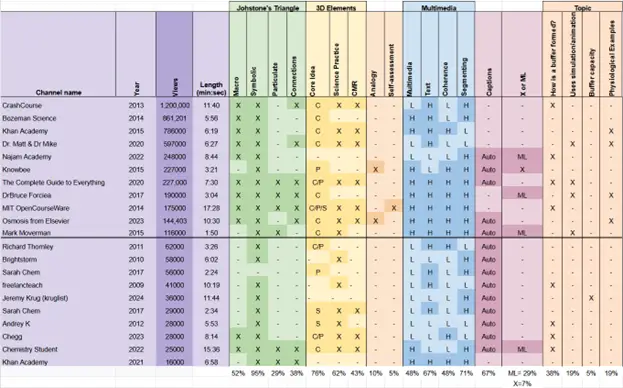
Patterns
General
We noted a few general observations during our coding. All the videos coded addressed the topic of what is a buffer and/or how it works. This is a reflection of our definition of the concept of interest criteria. There were two other topics that were addressed in some of the videos: how is a buffer formed (8/21) and buffer capacity (5/21). Additionally, several videos used animations or simulations (4/21). We also encountered 4 videos that heavily relied on physiological examples, including some where explaining physiological buffer systems was the core focus of the video.
Many videos defined a buffer as a solution that resisted a change in pH; however, with respect to identifying whether a science practice was present, we did not consider this as presenting a phenomena unless the video showed visually how a buffer’s pH stays constant when strong acid or base was added OR showed how adding same amount of acid to water changes pH a lot more than when added to a buffer system (either mathematically or visually). Finally, we noted a series of three related videos from Sarah Chem that provided an insight. The video with the most views (~290,000) did not contain conceptual components. However, the other two videos the conceptual components of a buffer system. Yet these videos had far fewer views. Although best practices suggest the importance of chunking videos into smaller focused videos, these videos highlight the risk that this many lead to critical concepts being missed due to lack of viewing a full series of videos.
Johnstone's Triangle
As with other topics, almost all the buffer videos (20/21 or 92%) contained symbolic representations; however, for this topic videos more frequently contained macroscopic examples/representations (11/21 videos, 52%) than particulate representations (6/21 videos, 29%). This puts buffer videos on the higher end for macroscopic [18% (Bonding) to 95% (Entropy)] and lower end for particulate representations [16% (Le Chatelier’s Principle) to 79% (Gasses)] when compared with the other seven topics we have previously coded. This may be a limitation of the topic, in that it is relatively easy to show macroscopically using a colored indicator that when added to pure water small amounts of strong acid or base cause large pH change but when the same substances are added to a buffer solution, there is no notable color change. Yet, when talking about the chemical reaction that is taking place, this is more typically done with chemical equations as opposed to particle diagrams.
3D Learning Elements
Core Ideas were present in 16/21 (76%) of buffer videos. The average for presence of Core Ideas across all eight topics reviewed thus far is 63% with only one topic (enthalpy at 81%) that had a higher percentage of videos with Core Ideas than buffers. The most prevalent core idea was Change and Stability in Chemical Systems (12/21, 57%). This specific CI requires videos to explain how buffers are able to maintain an equilibrium and resist pH changes when additional acids or bases are added (or H+ is added or removed). The Particulate Nature of Matter was the next most common core idea (6/21, 29%,) To meet the requirements for this CI, the video needed to address buffers work by the components reacting with the added H+ or OH- and that will lose efficacy (and the pH change) once the buffer component is fully used. Three of the five videos that meaningfully addressed buffer capacity were the ones that met the expectations for this CI. The Atomic/Molecular Structure & Properties was addressed infrequently (2/21, 10%). To address this core ideas videos either addressed the fact that the acid/base components of the buffer may not neutralize each other (thus why conjugate pairs are used) or why strong acids/bases are not suitable for forming buffers.
Also notable, 13/21 (62%) of buffer videos contained Science Practices (SP). This is the highest frequency of SPs for any of the topics coded thus far and notably higher than overall average across the previously coded topics (37%). Constructing Explanations was the most common SP coded for (9/21, 43%). This is likely because all the conceptual buffer videos we found and coded defined buffers as solutions that resisted a change in pH and to at least some extent focused on the topic of how buffers worked, though some videos also addressed other aspects of buffers such as buffer capacity or how buffers are formed. In explaining how buffers worked most videos (1) presented a phenomena or observation to be explained (resisting a change in pH), (2) made a claim related to the observation (that added acid or based must be used up somehow if pH does not change significantly), (3) used chemical reactions or particle models to show how buffer components reacted with added acid or base to neutralize it (scientific principle supporting claim), and (4) connected pH to concentration of hydronium/hydroxide (supporting why neutralizing the added acid or base would result in minimal change in pH). Some videos used models to support their explanations meeting the Developing and Using Models criteria (6/21 or 29%). The models varied a bit, with most involving particulate representations, but a few used a series of equilibria reactions to model physiological changes in the human body. One very robust example using Lego to highlight how systems (both buffered and unbuffered) respond to added acid or base. Although the Henderson-Hasselbalch equation was typically used as a mathematical tool, one video did incorporate the SP of Using Mathematics and Computational Thinking (SP5) describing how the Henderson-Hasselbalch equation actually relates to the buffer system.
Causal Mechanistic Reasoning, (CMR), was also relatively high for the buffer videos with 9/21 (43%) videos having CMR compared to previously coded topics (average of 30%). This is not surprising as most videos that address the science practice of constructing explanations also contain CMR. Videos most frequently elaborated on how and why buffers resist pH changes. The how component was typically demonstrated through neutralization reactions between buffers components and added acids or bases, while the why aspect centered on equilibrium shifts that stabilize pH. However, there were several videos that were found to meet criteria for the constructing explanation SP, but were not found to contain CMR as they did not adequately address the why aspect of the explanation which includes the equilibrium nature of buffers. Rather the videos presented a buffer as something that had two separate components, one that could react with acid and the other with base, failing to address the fact that these two components are in equilibrium.
A few other videos explained other aspects of a buffer. Namely What makes a good/poor buffer? (2/21 or 10%) addressing the need for an equilibrium system and explicitly addressing that a strong acid (or base) and its conjugate will not work because they do not exist in equilibrium with one another. Another two videos focused on explaining buffer capacity and the breakdown that occurs once buffer components are exhausted. We had identified another possible CMR question focused on the specific pH range over which a buffer remains effective, but we saw no videos address this topic. Overall, a majority of the videos containing CMR focused on pH resistance, with fewer videos discussing buffer capacity limits and effectiveness. This may be helpful for instructors who are expecting different levels of depth of knowledge from their students.
We again saw strong connections between the CI, SP, and CMR throughout the 21 buffer videos. All videos with CMR also had a SP. All such videos also had CI, but since the CMR often involves answering a question about the system related to a CI, this alignment is more typical. Interestingly, almost all videos that contained CMR also included macroscopic representations (8/9, 89%).
Multimedia Patterns
Of the videos coded, text usage and segmenting had the most “high” ratings with 14 (67%) meeting those expectations. Image usage and coherence were both lower with 10 (48%) meeting the criteria for “high”. It is striking for these videos that the videos with more than 100,000 views tend to score much higher on the full set of multimedia principles than those that are less watched (see Table above). Such videos also were more likely to have the 3D elements as well as CMR. This has not been a trend for most previous explored topics.
Videos that included either macroscopic and/or particulate representations of buffers tended to rate higher on many multimedia criteria. It is not clear why this is, but many of those videos without such representations simply involved someone recorded in front of a whiteboard. Such videos frequently score low on image usage and coherence due to the limitations of that style of video.
Content Accuracy and Accessibility Patterns
From the 21 coded Buffer videos, four (19%) had misleading content and one (5%) had inaccurate content. Although buffer videos contained a similar amount of misleading elements when compared to the seven previously coded topics (30% average), they had fewer scientific inaccuracies (7% for buffers, 21% average for other topics).
The misleading content included verbal descriptions that suggested that buffer systems would oscillate, rather than being and equilibrium; stating that buffers ‘remove’ acid from solution, rather than reacting with the added acid; and indicating that pH doesn’t change when acid is added to a buffer solution rather than only changing slightly. There was also oversimplified visual representations about acid dissociation. The video with inaccuracies contained multiple errors.
The use of analogies throughout buffer videos was low compared to previous topics, with only 2/21 videos (10%) containing analogies. This is the lowest percentage of analogies present in any individual topic. It is not clear if this is because the concept does not lend itself well to analogies or that the video creators believe that the content is understandable without such analogies. Self-assessment was also notably low, with only 1 video (5%) encouraging viewers to pause and reflect on a concept. This was also the lowest percentage of self-assessments present within any topic.
All 21 buffer videos were captioned. Of these, 14 (67%) used autocaptions, which may have included spelling/punctuation/capitalization errors, while 7 (33%) had no issues. The more highly watched videos tend to also be fully captioned. The reliance on autocaptions in videos may make it more difficult for students to accurately learn buffer content, as transcription errors can distort terminology and explanations.