Enthalpy Video Analysis Summary of Findings
Overview
This was a difficult topic to find videos for. We have a large number of search terms that we tried.
- Enthalpy
- Enthalpy of reaction
- What makes a reaction exothermic
- Endothermic vs. exothermic reaction
- Endothermic reaction
- Exothermic reaction
- Why do reactions have energy changes?
- Change and Stability, enthalpy, video
The list of search terms was refined after prescreening several videos and finding many that focused on Hess’ Law or general heat calculations. Based on these initial observations we targeted our analysis on conceptual videos focused on the enthalpy of chemical reactions and what impacts the variability of energy change associated with the chemical reactions. We are not actively including other changes such as phase changes. We explicitly excluded videos focused focus solely on the skill of calculating the ΔHrxn or a specific quantity of heat associated with a reaction occurring.
Searches by multiple people using these terms yielded a set of 32 videos that did not upon immediate observation appear to be videos solely focused on enthalpy calculations. One of these was eliminated as it was too long (over 15 min.). Most of the remaining videos (23/31) had above our general threshold of 100,000 views; however, we initially kept all the videos that showed up in multiple searches and did not immediately appear to be solely focused on enthalpy calculations for initial screening given the already smaller number of videos.
In prescreening we eliminated an additional 14 videos not meeting our concept of interest. Two videos showed only macroscopic examples without any discussion of concepts, one was geared towards elementary aged students, and one focused on determining if a reaction was exo or endothermic but there was no conceptual discussion of enthalpy. The remaining seven videos were eliminated because although they may have started with a definition of enthalpy, they largely focused on doing example mathematical problems or discussing the mathematical equations associated with enthalpy. An additional video was eliminated during coding as it was found to focus on enthalpy of physical systems such as gas expansion as opposed to chemical reactions. In the end, 16 videos were coded fully by two faculty and six undergraduate research assistants and the results of this coding is summarized in the table below.
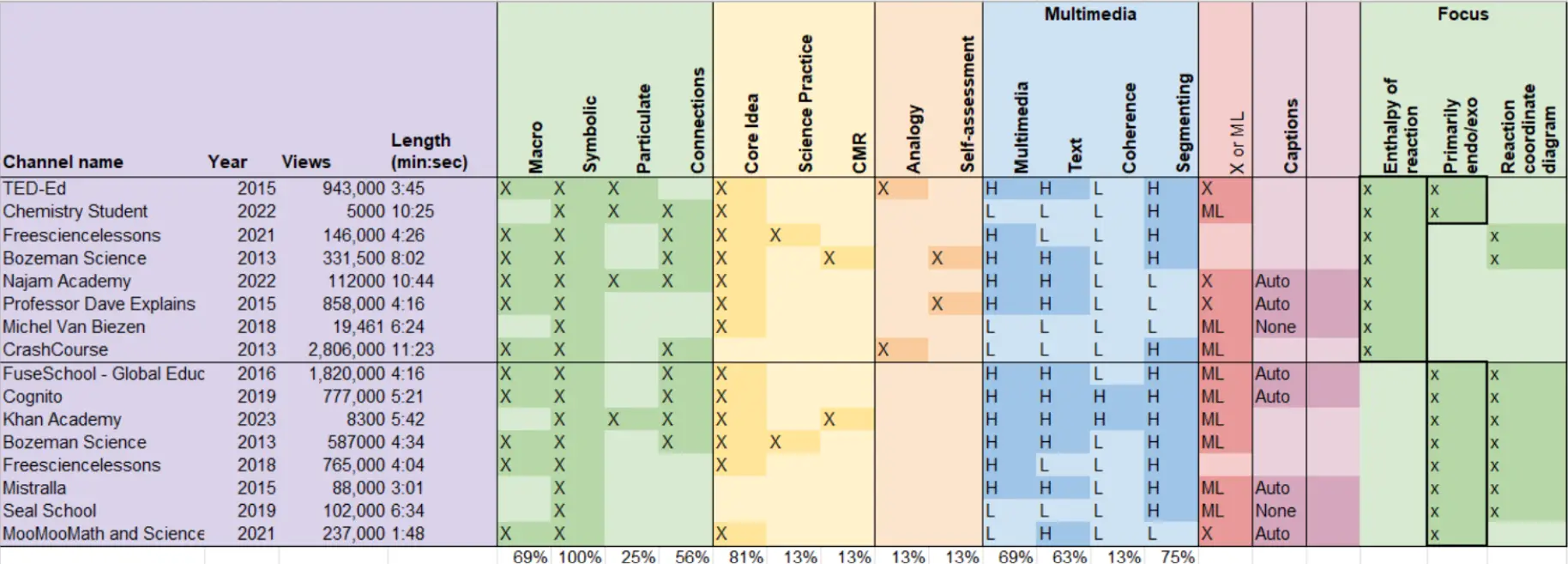
The majority of the videos focused on the general concept of enthalpy of reaction or targeted toward exothermic vs endothermic reactions with two videos addressing both topics. Additionally, many of the videos also addressed reaction energy diagrams. This representation was found in 7/10 of the videos that looked at endo vs. exothermic reactions and 2/8 videos that focused more generally on enthalpy of reaction (see right side of figure).
Patterns
General
As with most of the other topics we have studied (Le Chatalier’s Principle, Intermolecular Forces, Bonding, and Acids), all of the videos we coded contained symbolic representations. This is not surprising given that chemistry is most frequently taught at the symbolic level as this is the “language” of chemistry. For this topic, There were also a large number of videos (11/16 or 68.7%) that contained macroscopic elements. This is similar to what we saw for gases (70.8%) and IMFs (66%) videos and considerably higher than what we observed for bonding (18%), LCP (28%), and acids (52%). This is perhaps not surprising as enthalpy, gases, and IMFs, particularly when you are considering physical properties, have very clear connections to macroscopic phenomena. For example, you can easily observe a fire giving off heat or being used to cook something, a balloon getting smaller as it is cooled, or substances with different types of IMFs having different physical states. Though there were generally no differences in videos based on when they were created or how long they were, we did note that videos with fewer views (at or below 100,000) did not contain macroscopic examples.
The enthalpy videos we coded had a relatively large number of videos (81%) that were found to address a core idea as compared to other topics which ranged from 28% for LCP to 73% for IMFs. Additionally, they had a higher number of videos that were found to have misleading parts (56%) than other topics (12-32%). On the other hand, the enthalpy videos had relatively fewer particulate representations (25%), similar to values that we found for LCP (16%) videos. We also found few enthalpy videos that contained elements of Science Practices (2/16) or Causal Mechanistic Reasoning (2/16).
3D Learning Elements
Out of the 16 videos coded, 13 of the videos contained Core Ideas while only 2 contained science practices and 2 contained Causal Mechanistic Reasoning. The high percentage (81%) of videos with CIs stands out compared to other topics (21-73%), while the percentage of SP and CMR are relatively low (13%).
Two different CIs were identified for the topic of enthalpy. The most frequently addressed CI was Energy with 12/13 of the videos containing CIs addressing Energy. We noted two different approaches in which Energy could be addressed, either with a focus on the overall relative energy of the reactants and the products or through a focus on the relative bond/IMF energies that must be broken and formed as reactants are converted to products. 11/12 of the videos that were identified as meeting the Energy CI criteria addressed the overall energy difference between the reactants and the products. In our coding, this connection needed to be made explicitly, so simply indicating that” an endothermic reaction absorbs energy” would not meet the threshold, but indicating that “an endothermic reaction absorbs energy so that the products now have greater energy than the reactants” would meet the criteria. 4 of the 12 videos that met the Energy CI addressed Energy from the bond perspective stating that the relative strength of the bonds within the reactant and products would determine if energy was absorbed or released over the course of a chemical reaction. For Change and Stability, only one video was identified that met the appropriate criteria. To meet this core idea, a video had to address that chemical reactions are more favorable in the exothermic direction because this will result in a lower energy system. The video that met this criteria was one of the videos with <100k views and was part of a physics lecture series. As such, it took a more physics oriented approach to explaining enthalpy and provided a much deeper explanation of enthalpy than many of the other videos in the overall set. It was noted in our evaluation that this video may hold significantly less appeal to most students in a general chemistry class.
Only 2 of the 16 videos met the criteria of containing a SP. Both of these were identified as having the Constructing Explanations SP. In both videos, the explanation was built around a reaction coordinate diagram and using it to explain the energy changes associated with a chemical reaction. Two other videos were identified as having CMR present. As meeting the criteria for CMR required a focus on the energy associated with bonds, it was unsurprising that both of these videos addressed the bond energy focused CI. One of the videos was also coded for Energy CI associated with overall reactant and product energy. It is worth noting that one of these videos (by Khan Academy) had only 8000 views at the time of analysis. This was a video that had only been posted for about 1 year and 3 months, but seemed like a surprisingly less viewed video from a very well known channel.
- Are there any connections between any of these?
Multimedia Patterns
The multimedia principles followed by the videos were mixed. Coherence was once again low, with only 2/16 videos scoring high in that category. The reasons for achieving low varied, though several were for the speaker being constantly on the screen, a consistent choice made by several channels. Segmenting on the other hand was the multimedia category that had the most “high” evaluations (12 of 16 videos). Most of those that scored low (3/4), simply had many topics addressed without some coherent structure that was shared with the viewer. The images and text usage had similar distributions with 11 videos rates as high for images and 10 high ratings for text usage. The reasons for the lower images tended to be long stretches of videos without meaningful images being used (sometimes just the speaker) or low quality images.
Content Accuracy and Accessibility Patterns
There were a comparatively large number of entropy videos that were considered to contain misleading information. For other topics 12-33% with an average of 24% of the videos were coded as containing misleading information whereas for enthalpy it was 9/16 or 56% of the videos that were identified as having misleading content with another 4/16 (25%) identified as having content errors. Many cases of misleading or incorrect content were unique such as incorrect chemical formulas, confusing IMFs with bonds, an error with state function identification, or incorrectly identifying cooking and splitting of water as physical processes. However, 6/16 videos were flagged as having incorrect or misleading content as they stated or implied that energy is contained in bonds and thus released when bonds were broken. The difference between incorrect vs. misleading is that if the video explicitly said that energy was released when a bond was broken in a chemical reaction then it was viewed as inaccurate. If the video talked about energy being stored in bonds it was coded as misleading. This is particularly problematic students’ frequently struggle in constructing a correct and coherent understanding of energy at the atomic−molecular level as they use the unproductive idea that that breaking bonds releases energy (Barker & Millar, 2020; Galley, 2004; Teichert & Stacy, 2002). Research has shown that even after instruction about half of students still frequently apply the idea that bond breaking releases energy. (Barker & Millar, 2020; Gonzales, 2011) and that even some graduate students retain this nonproductive idea (Cooper & Klymkowsky, 2013).
As usual most of the enthalpy videos were (14/16). Eight of the videos were fully and correctly captioned. Of the remaining, four were auto captioned, while one was missing only punctuation and one missing only capitalization. The two uncaptioned videos were surprising as both were in English and YouTube typically automatically auto-captioned such videos.