Gas Law Video Analysis Summary of Findings
Overview
Videos were initially identified using the following key search terms on Youtube:
- Ideal Gas Laws, Gas Laws,
- Why Do Gases Act Like They Do in Chemistry?,
- Avogadro’s Law,
- Charles’s Law,
- Boyle’s Law,
- Boyle’s Law in Chemistry,
- Ideal Gas Properties.
Videos were then filtered, with those over 90,000 views, video lengths under 15 minutes, and translated into English language being considered in the initial pass. This yielded 36 videos, each of which was briefly reviewed to determine if they fit the desired concept of interest. Given our interest in conceptual understanding of gases, we chose to eliminate videos that just focused on using gas laws to solve numerical problems and instead focus on videos that qualitatively discussed the relationships between volume, pressure, and temperature for samples of gases or the deviation of real gases from ideal gas behavior. This further reduced our set of videos to 19 which were analyzed to look for the presence of Johnstone’s Triangle, 3D Learning Elements, and multimedia principles. After fully analyzing these 19 videos we noted that most of the videos focused on the Core Idea of Change and Stability and addressed single gas laws as opposed to the ideal gas law. A focused search of the videos identified in our initial search but with fewer than 90,000 views identified an additional five videos that either addressed the ideal gas law or focused on a Core Idea other than Change and Stability. Out of the final 24 videos that we analyzed fully, it was noted that 16 followed a format of discussing a gas law conceptually followed by the solving of practice problems using that gas law and that 12/16 of these videos focused on just a single gas law.
Results
General Patterns
The results of the analysis for the 24 coded videos is summarized in Table 1. Table 1 is sorted by the type of video as we noted a few main video formats. The most common type of video addressed a single gas law conceptually followed by solving mathematical problems related to that gas law. There were also a few that followed this same format but with the ideal gas law. The other main type of video we found focused on discussing real gases and how their behavior deviated from ideal gas behavior. Overall we noted that newer videos were more likely to contain animations and had less of a focus on problem solving. Only 4/10 of the videos posted since 2018 incorporated mathematical problem solving and of those that did include problem solving it was 25% or less of this video. Before 2018, 12/14 had embedded problem solving practice with three videos exceeding 50% of the total time used for problem solving. Below is a more detailed discussion of the patterns we noted.
Table 1: Gas Law Video Analysis Data Sorted by Topic
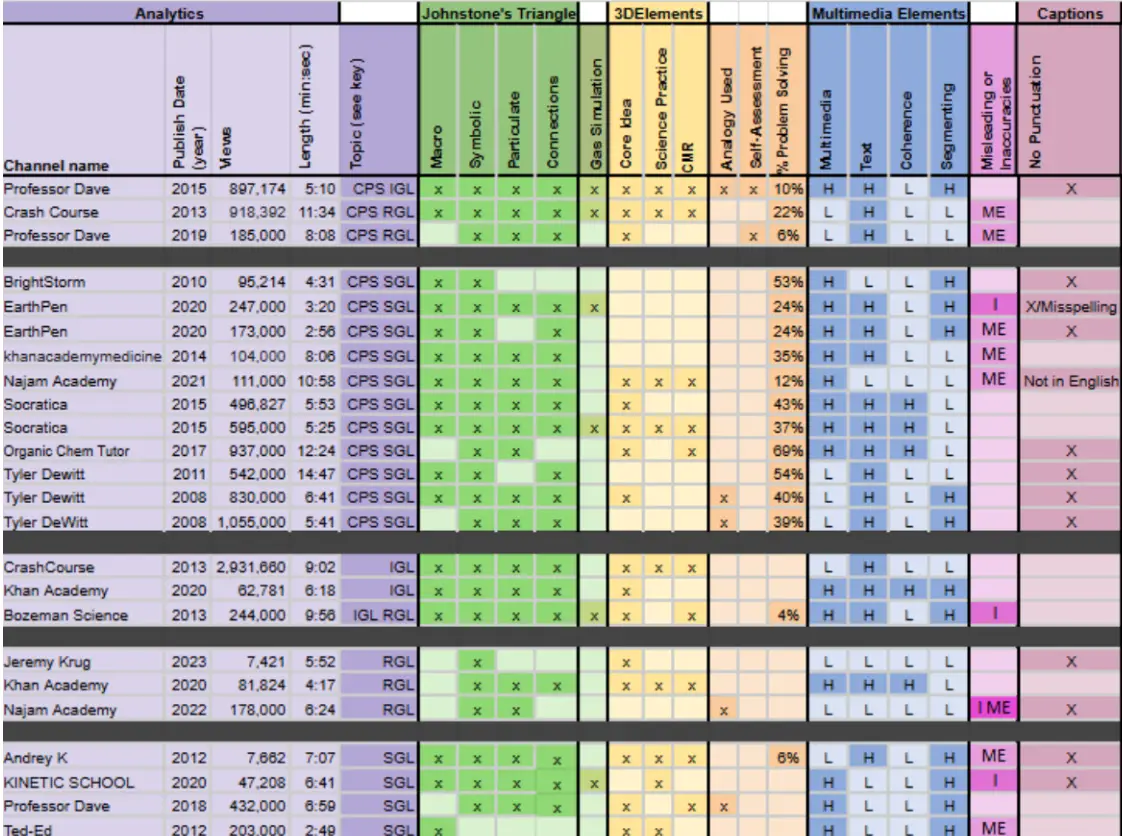
Topic Key: CPS = Conceptual and Problem Solving; IGL = Ideal Gas Law; SGL = Single Gas Law; RGL = Real Gases
Johnstone’s Triangle Elements
Consistent with the other topics we have analyzed videos for (Le Chatelier’s Principle (LCP), Bonding, and Intermolecular Forces (IMFs)), Gas Law videos used symbolic representations. However, unlike the other topics, we analyzed one video that did not include the symbolic level, but focused only on macroscopic representations. For the Gas Law videos overall we noted a high number of videos with macroscopic (70.8%) and/or particulate representations (79.2%). Videos for other topics used these levels of representations less frequently. Though IMF videos came close with 66% of the videos containing macroscopic representations and 73% of the videos containing particulate representations; however, Bonding and LCP respectively had 18% and 28% macroscopic and 46% and 16% particulate. This is perhaps not surprising as both gases and IMFs, particularly when you are considering physical properties, have very clear connections to macroscopic phenomena. For example, you can easily observe a balloon getting smaller as it is cooled or you can observe substances with different types of IMFs having different physical states.
For the Gas Law videos, the most common macroscopic representation included images or animations of balloons changing in size that revealed how the number of moles, temperature, or pressure affects volume. Of the 17 videos that contained a macroscopic example, ten were a balloon. Another common example used was a container with a movable piston to show the relationship between variables in both Boyle’s (P and V) and Charles’s Law (T and V). Common symbolic representations included graphs that illustrated how variables were related (i.e. pressure and volume) and the mathematical relationships for the various gas laws. Particulate representations showed the movement of gas particles whether it be visually seen through an animation, or through arrows drawn on an image. We noted that six videos used a simulation or animation that showed gas particles bouncing within a container to help explain the relationship between the variable of P, V, n, and/or T, all of which contained all levels of Johnstone’s Triangle and made connections between the levels.
3D Learning Elements
The 3D learning elements of Core Ideas, Science Practices (SP), and Causal Mechanistic Reasoning (CMR) were found in many of the videos analyzed. Core Ideas were found in 16 of the 24 gas law videos (67%). The most common Core Idea present was Change and Stability which discussed how changing one variable (pressure, temperature, volume, or moles of gas) caused changes in a second variable based on particle motion. For example, raising the temperature, while keeping volume and number of moles of gas constant, increases the pressure of the gas as the particles are moving faster and thus bounce off of the container walls more frequently. Fewer videos addressed the Core Idea of the Particulate Nature of Matter (4 videos) or Atomic and Molecular Structure and Properties (4 videos). Videos that contained the Core Idea of the Particulate Nature of Matter focused on using Kinetic Molecular Theory to explain gas behavior and explicitly discuss that the pressure exerted by a gas was the result of particles colliding with the sides of the container. For Atomic and Molecular Structure and Properties, the video addressed how the nature of the gas particles caused real gases to deviate from the ideal gas law.
The gas law videos exhibited a range of Science Practices. In nearly all cases, the SP were only found in videos that also had Core Ideas present. One video was marked with a SP, but no Core Idea, but the attempt to include a Core Idea was made, though was incorrect and thus was not marked as a Core Idea. In general, this supports the broader approach of using SPs as a first filter for videos likely to fully embrace all aspects of 3D learning. Of the SPs, Developing and Using Models, and Constructing Explanations were both very common with Using Mathematics and Computational Thinking and Analyzing and Interpreting Data also present.
It is not surprising that any video with CMR also had a Core idea as our Causal Mechanistic Reasoning (CMR) “what” questions were linked to the individual Core Ideas. Most of the videos that had causal mechanistic reasoning answered the question “What happens to one ideal gas property (P, V, T, n) when there is a change in another (assuming the others are kept constant)?” These videos all addressed how changing a given variable caused a change in particle motion which in turn affected the other variable of interest with an explicit discussion of particle collisions with the walls of the container. Two videos addressed how and why real gases acted differently from ideal gases in a way that constituted causal mechanistic reasoning, but the majority of causal mechanistic reasoning came in the form of describing ideal gas property relationships.
Most interestingly, when considering only videos containing Core Ideas, we find that CMR and SPs appear together. 70% of videos (7/10) with Core Ideas and CMR also had SPs. Of the videos with Core Ideas and no CMR, only 1/6 had a science practice present. Again, this is supportive of using the presence of SP as a identifier of higher quality videos.
Multimedia Patterns
Overall, the gas law videos effectively incorporated many of the multimedia criteria with 71% using minimal text and 62% containing meaningful and relevant images for supporting conceptual learning that were well explained for the novice learner. Half of the gas law videos coded as high for segmenting (12/24) meaning that they contained elements such as introductions, section titles, or a video summary to support student organizing content or identifying key ideas. Videos evaluated as high for image content often used some form of particulate/macroscopic animations (moving particles, balloons changing volume, and pistons moving with added pressure). The coherence was lower for this topic (21%) than other topics previously explored (LeChatelier’s Principle, Bonding, IMFs). Gas law videos that contain low coherence typically have the narrator’s face present on screen throughout the video or their hand is shown writing calculations.
Content Accuracy and Accessibility Patterns
As with other topics, we noted over half of the videos (13/24) relied on YouTube’s auto captioning. Overall, this did a reasonably good job with spelling, with only one video having issues with spelling of technical terms. However, it may also be the case that there are not as many technical terms involved in this topic as there is with LCP were we noticed a much higher level of misspelling. Auto-captioning does not provide capitalization or punctuation, which could be problematic if the learner had to solely rely on the captions as we know that capitalization and punctuation are important in helping readers understand the meaning of the message.
Compared to other topics, fewer videos contained inaccurate content (I) (4/24 or 17%). However, the misleading elements (ME) were more frequent (7/24 or 29%), rivaling the rate seen in the IMF videos. Most common were misleading visuals and unclear or incorrect relationships between ideal gas variables (P, V, n, and T). Eight videos had inaccurate visuals, mainly misrepresentations of gas particles (ex: molecules increasing in size as their temperature increased.) Five videos presented incorrect or unclear explanations of the relationship between gas variables (ex: as temperature increases the gas particles will move away from each other.) An additional four videos incorrectly portrayed or explained mathematical problems or graphs (ex: saying PV/RT is always 1.)
These inaccuracies present challenges for novice learners. Inaccurate representations of gas particle motion and behavior can lead to the development of inaccurate mental models which not only affects understanding of the ideal gas behavior, but other chemistry concepts. For example, believing that a particle’s size increases with increasing temperature also inhibits understanding of why volume changes as substances are heated or cooled.
Videos that had misleading information or inaccuracies tended to be less viewed. The 14 lower viewed videos (<400k) had more misleading elements and inaccuracies (71%) compared to higher viewed videos (10%). This may be because lower view videos often come from smaller, less subscribed to channels with fewer resources to check errors and review content compared to more highly subscribed to channels. Videos that covered single gas laws versus the ideal gas law or real gases did not have significantly more errors, so it does not appear to be an issue of covering a broader topic with more information.