IMF Video Analysis Summary of Findings
Overview
Using our general search process we found 45 videos that met our broad criteria including time length, language, educational focus, and stand-alone nature (not supplement to a classroom activity). The videos were given a first pass by two faculty members and two undergraduate students to ascertain whether these videos met the concept of interest. We noted that when using Intermolecular Forces as a search term there were a number of highly viewed videos that appeared near the top of the search list but did not address the concept of IMFs. For example, videos that focused on polar and non-polar molecules. Additionally, there were videos that mentioned IMFs but did not really focus on them to any extent and other videos that discussed how to answer a very narrow IMF related assessment question. Based on this we came up with the following criteria to identify videos meeting our concept of interest:
- To meet the concept of interest: Videos must either describe HOW IMFs are formed OR explicitly connect physical properties of substances to TYPES and RELATIVE STRENGTHS of IMFs. This left out videos that focused on just identifying the kinds of IMFs present for different compounds.
- Videos designed to just answer a very narrow question (e.g., which substance would have a bp closest to that of Ar?) are not ones we will do a full evaluation of.
- Videos where IMFS are mentioned and explained but the focus is not IMFs, e.g.,a video focused on the physical properties of water are not ones we are going to evaluate.
Applying these additional selection criteria resulted in the exclusion of 12 videos, leaving 33 videos for detailed analysis by two faculty and five undergraduate research students. Of the 33 videos, 21 of the videos exclusively focused on IMFs and 12 of the videos focused on IMFs and their relationship to physical properties of the compounds. The final agreed-upon ratings of the videos are summarized in Table 1.
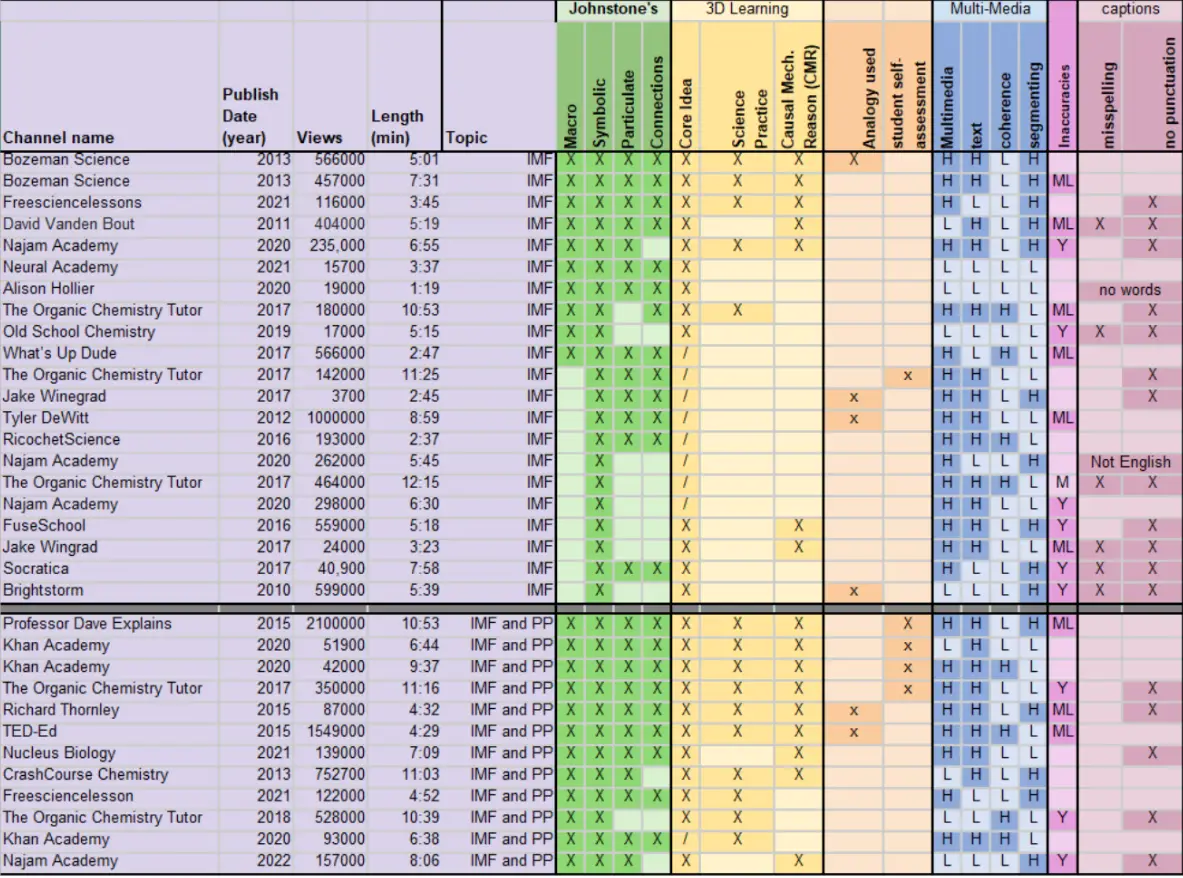
Table 1: Summary of video coding for IMF videos. Videos are sorted by whether they focus exclusively on IMFs (top portion) or if they focus on IMFs and how they relate to physical properties (bottom portion). Within those blocks, videos are sorted by the presence of macroscopic representations, then causal mechanistic reasoning. The “/” in the Core Idea concept column meant that a partial core idea was present (see below).
Patterns
Most Common Elements
Based on these data, we noted several patterns. As we have noted with previous topics, Bonding and Le Chatalier’s Principle, all of the videos contained symbolic representations. This is not surprising given that chemistry is most frequently taught at the symbolic level as this is the “language” of chemistry. However, we also noted that the majority of videos also included macroscopic and/or particulate representations, and most of the videos with more than one type of representation explicitly connect at least two of these representation levels in the video. Some common patterns noted were the combination of particulate and symbolic representations where dipole symbols and dotted lines representing attractive forces between particles (IMFs) included in images that showed a number of particles interacting. Sometimes the particles were depicted using ball and stick type figures and in other cases Lewis structures of molecules were used to represent the individual particles. Macroscopic representations focused on specific physical properties of substances, most commonly melting points and boiling points, but density, viscosity, solubility, and states of matter were discussed in some videos. Frequently, the macroscopic properties were presented as data, for example boiling point trends.
3D Learning Elements
We found that videos that discussed both IMFs and their connections to physical properties, as compared with those that just discussed IMFs, were more likely to incorporate multiple levels of Johnstones triangle, particularly macroscopic level representations, as well as full core ideas, science practices, and causal mechanistic reasoning. In looking at Core Ideas, we identified three underlying core ideas found in videos: energy, electrostatic bonding and interactions, or structure and property. We operationalized each of these as follows:
Electrostatic Bonding and Interactions
Intermolecular forces (attractive noncovalent interactions) exist between atoms/molecules due to instantaneous, induced, and permanent dipoles. AND The strength of the attraction depends on the size of the dipole. (Needs to have this last part!)
Structure and Properties
Physical properties of molecular compounds can be explained based on the type(s) and strength(s) of IMFs that exist between particles. AND Describe how a change to the strength of the IMF will influence the physical property (e.g. as IMF strength increases, boiling point will increase.)
Energy
Energy is required to overcome intermolecular attractions between molecules to change phase from solid to liquid to gas and conversely is released to surroundings when molecular compounds change phase from gas to liquid to solid. Discussion of phase changes is not required though.
From Table 1 we can see that all videos contained either a full or partial core idea. This is in contrast to Le Chatelier’s Principle where very few of the analyzed videos contained any core idea or Bonding where about half of the videos contained a core idea. For IMFs, Energy was the core idea that was least frequently addressed in the videos (only 6 out of 33). It was also the case for Le Chatelier’s Principle and Bonding videos that the Energy core idea was least frequently incorporated. The concept of IMFs was most frequently approached from the perspective of Electrostatic Bonding and Interactions with 28 of the videos having this as their partial or full core idea. The partial core idea was marked for those videos that discussed electrostatics as the basis for attraction, but did NOT address the important idea that the strength of the attraction depended on the size of the dipole (see description of operationalization above). This was present in 9 out of the 33 videos. The full or partial core idea of Electrostatic Bonding and Interactions was frequently the only core idea addressed in videos focused on IMFs and not their connection to physical properties. Videos that addressed both IMFs and physical properties were more likely to incorporate more than one core idea (6/12 as compared with 3/21).
Science Practices (SPs) were more commonly identified in the IMF videos analyzed (15 out of 33) than for previous topics (Le Chatelier’s Principle and Bonding). Notably, nearly all of the videos focused on the connection between IMFs and physical properties included one or more science practices (10 of 12), whereas only 5 of the 21 videos addressing just IMFs included SPs. Of the practices noted across the data set, constructing explanations was most common followed by using models and analyzing data.
We anticipated that causal mechanistic reasoning (CMR) would potentially answer one of three different questions. They were:
- Option 1: What governs the strength of attraction between molecules (IMFs)?
- Option 2: What drives the formation of attractions between molecules (IMFs)?
- Option 3: What is the relationship between different types of IMFs and physical properties?
Sixteen of the 33 videos addressed the criteria to meet at least one of the causal mechanistic reasoning criteria. Having nearly 50% of the videos including CMR is higher than has been seen in other topics (Le Chatelier’s Principle and Bonding). Option 1, focusing on the strength of attraction between molecules, was the most common with all but 2 of the videos with CMR answering this question. 6 of the videos addressed option 3 which focus on the relationship between type of IMF and physical property. None of the videos focused on how the potential energy of the system decreases when IMFs are formed between the molecules. This suggests a potential area for future videos to address.
When considering the split between the focus on IMFs only or explicitly addressing IMFs and their relationship to physical properties, we note that the inclusion of CMR is more common when the connection between IMF and physical properties is part of the video. 9 of 12 of these videos included CMR, whereas only 7 of 20 videos focused only on IMFs included CMR. Unsurprisingly, CMR Option 3 was only noted for videos that addressed the relationship between IMFs and physical properties.
Multimedia Patterns
In considering Mayer’s Multimedia principles, the reduction of extraneous cognitive load was the greatest challenge as the principle of Coherence was most frequently violated. Videos coded high for coherence were the ones that did not contain things that could distract from the learning such as extraneous content, music or other distracting sounds, unrelated graphics or animations, distracting background changes,or just too much stuff on the screen at one time. It is notable that these videos were largely ones considered more “low tech”, e.g., Khan Academy and Organic Chemistry Tutor videos, where the instructor was just drawing or writing on the screen as they narrated. The most common reasons that videos were coded low for coherence were that the instructor was on the screen the full time, distracting elements such as flashing transitions or background music, or the inclusion of side-topics that were related to the content but not relevant to learning the concept. Conversely, the videos that were coded high for coherence were all coded low for segmenting which indicates they did not contain elements to meaningfully help learners organize content or identify key ideas.
Content Accuracy and Accessibility Patterns
With respect to accessibility, just over half of the videos we analyzed relied on YouTube auto captioning which means that there is no capitalization or punctuation. For most of the auto captioned videos (11/17) that was the only issue; however, in six of these videos we also noted some misspelled words. Very few of the videos incorporated analogies or encouraged opportunities for students to self-assess. It was interesting to note that videos that did contain analogies were the older ones, posted prior to 2017. Another common issue that was noted in the IMF videos was that of language use and imprecise use of terms. For example, seven of the videos referred to IMFs as bonds and two of the videos talked about individual molecules having IMFs. In several cases it was not made explicit in the video that the hydrogen bonding interaction was between two different molecules and not within a single molecule. Some videos referred to overcoming attractions between molecules as “breaking the bonds”, or when talking about boiling points of a substance referred to the boiling point for a single molecule of that substance. This imprecise use of language is problematic given that the research tells us students struggle with understanding that IMFs are attractive forces between molecules and that they are different from chemical bonds.