Kinetic Summary of Findings
Overview
As kinetics is broad topic, we were looking for videos that focused on the conceptual understanding of reaction kinetics in chemical systems which included how reaction rates are influenced by various factors, the interpretation of rates of reaction, and the mechanisms of reactions. When considering the interpretation of rates of reaction, the videos were expected to make a connection between order and either collisions or mechanism. We were not focusing on videos that exclusively solved mathematical problems involving reaction rates without addressing the conceptual aspects or videos that just addressed collision theory but did not address any aspects of kinetics (reaction rates). We used the following search terms:
- Reaction kinetics
- Chemical kinetics
- What is reaction kinetics?
- Reaction kinetics explained
- Factors affecting reaction rate
- Rate laws in chemistry
- Reaction rate examples
- Collision theory in kinetics
- Activation energy in reactions
- Reaction mechanisms
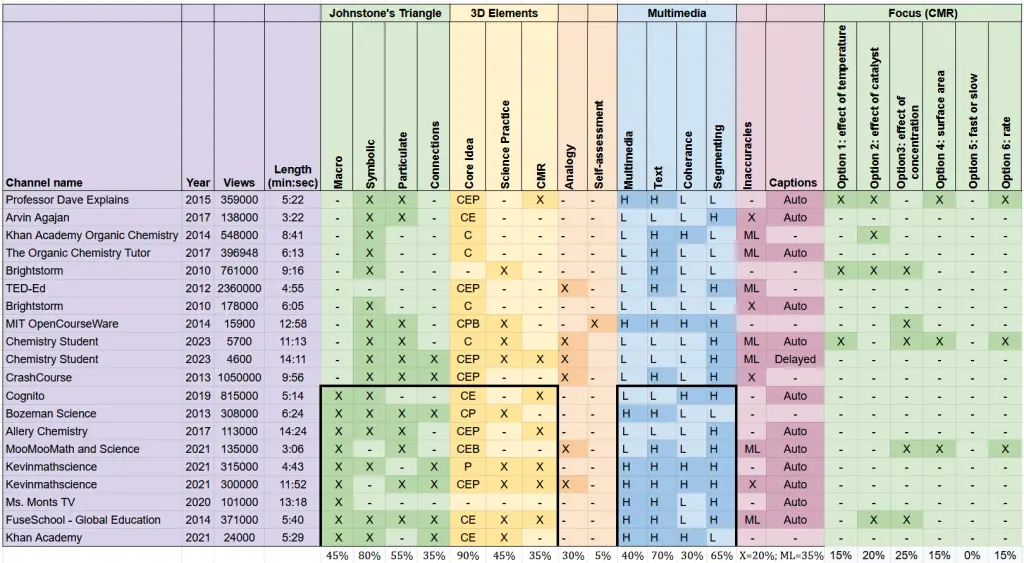
Our search yielded 58 potential videos that were in English, less than 15 minutes, focused on education, and seemed to meet our concept of interest. Focusing on videos with more than 100,000 views, in an attempt to identify the videos students would most commonly encounter, yielded 27 videos to code. Through coding, 13 were identified as meeting our concept of interest, with those not meeting it primarily just focusing on collision theory or showing how to determine the rate law for a reaction solely from a mathematical perspective. As we generally aim for a set of 20-25 videos, we reviewed the videos from our initial search with fewer than 100,000 views to identify ones that likely met the concept of interest and/or were from creators that we have found to produce quality videos for previous topics. This provided us with an additional 11 videos to analyze, seven of which were found to meet the concept of interest. In total, we ended up with a final data set of 20 videos that were coded individually by 2 faculty members and 6 undergraduate research assistants; the coding results are summarized in the table below.
Patterns
General
We noted a few general observations during our coding. Mostly of the videos (14/20) addressed the topic of what factors impact reaction speed. We also noted that the presence of macroscopic representations generally aligned with better overall content of the video.
Johnstone's Triangle
As with previous topics, we found that the majority of kinetics videos analyzed contained symbolic representations (16/20, 80%). However, this was notably lower than other topics where 95-100% of the videos had symbolic representations, with the exception of entropy where only 75% of the coded videos contained symbolic representations. This less frequent presence of symbolic representation may be due to the nature of kinetics being better explained through a different method of representation, such as particulate, as it relates to collisions of particles.
The other two elements, macroscopic and particulate, were noted less frequently. This was again consistent with other topics. Particulate representations (11/20) were presented in more videos than macroscopic representations (9/20) (55% vs 45%); an observation we also found for the topics of Bonding, Intermolecular Forces, and Gas Behavior. Despite the fewer videos containing macroscopic representations, looking at the data as a whole showed that videos with macroscopic representations were more likely to contain particulate representations, have explicit connections between the representation levels, incorporate scientific practices and CMR, and score higher on multimedia elements – in particular the presence of meaningful images and content coherence. This pattern of macroscopic representations relating to better multimedia and conceptual elements can be due to the nature of a macroscopic example having to be shown clearly, explained well, and connected back to a conceptual idea. A strong example of this was a video that showed macroscopically how surface area (solid vs. powder) affected reaction rate and then explained this using particulate representations that showed greater interactions between reactant particles with the solid vs. powder, connecting this to the number of available atoms for collisions and collision theory. This also supports the idea that grounding instruction in macroscopic phenomena leads to the incorporation of more of the features that support conceptual learning.
3D Learning Elements
Core Ideas (CI) were present in 18/20 (90%) of videos. This is the highest rate that we have seen in topics to date. The most common CI present in kinetics videos was Change and Stability (17/20, 85%). This CI required the video to mention different factors (such as temperature, concentration, and catalysts) that can influence the rate of chemical reactions by changing the frequency/energy of collisions, or that some chemical processes involve multiple steps, and the rate is determined by the slowest step. Most videos addressed how the factors influence the rate, rather than addressing the aspect related to the mechanism. As such, it is natural to discuss how factors such as temperature or concentration will impact the rate of a reaction. The high level of core ideas is likely due to the fact that chemical kinetics inherently focuses on change that is occurring within a system, but may also be linked to how we defined the expectations for focusing on conceptual understanding of the videos, as we also noted a relatively high rate of videos that made it through the first pass that did not meet our concept of interest.
Energy was the next most frequently observed CI (11/20, 55%); to meet this CI, videos needed to address that particles must collide with sufficient energy to overcome the activation energy barrier in order to form products and mention that catalysts increase reaction rate by lowering the activation energy. Alternatively, the videos could explain that increasing the temperature of a reaction increases the energy of the particles and number of collisions. The next most common CI was the Particulate Nature of Matter (9/20, 45%) which was still addressed by many videos. Videos that met this CI mentioned that in order for a reaction to occur, particles must collide with sufficient energy and correct orientation. The last relevant CI, Electrostatic Bonding and Interactions, was not present in many videos (2/20, 10%). Videos that met the criteria for this CI mentioned how chemical reactions require the input of sufficient energy to break bonds between the atoms in the reactants or achieve the transition state. This is notable in terms of recognizing that videos actually explain why energy is necessary for reactions, instead expecting viewers to either intuit or already understand the link between breaking bonds requiring energy (a notoriously challenging concept to internalize).
Of the 20 videos coded, 9 videos (45%) were found to contain at least one Science Practice (SP), roughly midrange of previously coded topics. Five of the twenty videos (25%) exhibited Constructing Explanations. This SP arose when articulating how different factors influenced the rate of reaction using scientific principles or evidence of a chemical phenomena. Surprisingly, 3 videos (15%) were coded for Planning Investigations, which has been a very rare common Science Practices to observe in our dataset. Kinetics videos that met the criteria for this SP generally explained how one would design or run an experiment to determine the rate or rate law of a reaction. Of the remaining three coded Science Practices, one video Developed and Used Models to describe the different factors that impact the rate of reaction, one video exhibited Analyzing and Interpreting Data to examine the results of a hypothetical experiment for determining reaction rate, and one video used Using Mathematics and Computational Thinking to calculate the likelihood of a reaction occurring based on the probability of collisions between reactant molecules. The pattern observed across kinetics videos regarding the SP were unusual with the high number of Planning Investigations and relatively low levels of Developing and Using Models.
Causal Mechanistic Reasoning was present in 35% (7/20) of videos with most articulating how/why a specific factor influences the rate with many videos providing causal mechanistic reasoning that addressed multiple how/why questions. This is roughly average across the different video topics. Five of the videos (25% of the total) address the role of concentration on rates, 4 (20%) explained catalysts impact, and 3 (15%) addressed each the role of temperature’s and surface area’s impact on rates of reactions through causal mechanistic reasoning. Although some videos may have addressed what causes a reaction to be fast/slow no videos really linked the speed of the reaction to the underlying chemical bond breaking and making processes, either from an energetic standpoint (e.g. how is activation energy linked to bond energies or why would one step of a mechanism have a higher activation energy than another step).
Multimedia Patterns
Similar to other topics analyzed, the kinetics videos showed moderate inclusion of multimedia learning principles. Fewer than half of the videos (8/20, 40%) were rated highly for their use of images, which meant that the majority of videos either had limited images, unexplained images, or images that were not clearly meaningful in supporting a novice learner. Similar to other topics we have evaluated, coherence was the lowest multimedia component with only 30% (6/20) rating high for coherence. Low coherence indicates that videos contain elements that can distract learners from the critical learning elements, for example by playing background music throughout the videos or the inclusion of distracting images or animations. For the kinetics videos, lower coherence largely resulted from the presence of the instructor on the screen for the full video or just too much going on or too much content on the screen such that it was difficult to know what to pay attention to. Positively, most videos (14/20, 70%) limited the on screen text to keywords or definitions rather than full sentences which were also narrated. Limited text supports multimedia learning by avoiding redundancy and divided attention, helping learners process the content more efficiently. Further, 65% (13/20) of the videos were rated high for segmenting, indicating that the videos contained elements such as introductions, section headings, video chapters, and summaries that provide organizational support for students. For example, videos that focused on factors affecting reaction rates were often separated into several different sections, one for each factor (e.g., temperature, surface area, concentration).
Content Accuracy and Accessibility Patterns
Across the video body, there were no standout or consistent errors or misleading issues. Perhaps the most general kind of error was simply statements that are generally true, but not always. Examples of this include indicating that a rate will slow down in a concentration of a specific reactant will decrease (not true when the reaction is zero order for that reactant) or that a mechanism required 2 or more steps (ignores 1 step reactions). Beyond that most errors or misleading issues were one-off problems with videos.
Across the kinetics videos, instructors tend to rely heavily on macroscopic analogies to explain abstract molecular concepts, like collision theory, activation energy, and catalysts. For example, one video talked about a person riding a skateboard needing to provide energy to start moving by pushing off as analogous to needing to add energy to get a chemical reaction started (activation energy). These analogies make concepts more relatable by simplifying the molecular mechanistic reasoning. Collectively, the videos demonstrate a pattern of creating real-world comparisons for molecular-level explanations, which can aid in student development and retention of conceptual understanding. However, such analogies can also be problematic if viewers are not familiar with the analog concept and the analogy is just presented verbally. In the example described previously, the video used an animation of a person on a skateboard to provide a visual as well as verbal description of the analogy. However, if they only talked about the skateboard example without showing it, it would not be useful for a viewer who did not know what a skateboard was. In the case of kinetics videos, most of the videos that used analogies (⅚) presented the analogies both verbally and visually. Yet, overuse, poor choice, or lack of clear connection between the analogy and chemistry concept can also mislead students.
Most of the videos (12/18, 67%) were autocaptioned which means that there are no capitalization and no punctuation. Though this captioning is frequently quite accurate, we still often see chemical or technical words incorrectly captioned. However, only one of the five most watched videos was autocaptioned as many of these are from more highly produced. Unfortunately, one of the most watched videos that did not appear to be autocaptions still appeared to have some incorrectly transcribed scientific words.