LCP Video Analysis Summary of Findings
Overview
Le Chatelier’s Principle (LCP) was the first topic we explored. Each of the videos was initially coded by two faculty members and four undergraduate students. All members would meet to develop a consensus for the coding. After a refinement of the multimedia coding, one faculty member and three different undergraduates recoded and developed a consensus for each video with the newer multimedia criteria. Coding the videos resulted in the refinement of our video filtering process and coding framework. In particular, we noted in only coding the most viewed videos (>100,000 views), we were lacking videos with Causal Mechanistic Reasoning (CMR). Hence, we tried additional search terms and looked at videos with fewer views to try and identify some videos that contained CMR. This can be seen in Table 1 below which shows only 3 videos coded with CMR and none of these having more than 100,000 views. After filtering videos using our regular process and then looking to include additional videos that specifically contained CMR, we did detailed coding of 25 videos. The summary of the coding of these videos is shown in Table 1 below.
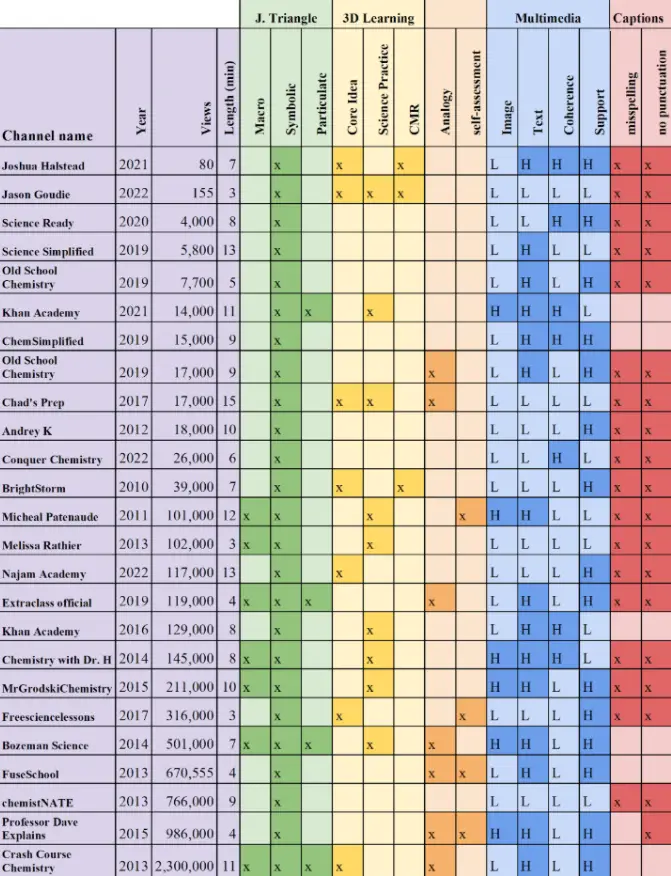
Table 1: Summary of Data from Coding of Le Chatalier’s Principle Videos Sorted by Number of View
Patterns
General
In general, it was noted that symbolic representations were found in all 25 videos. This is not surprising given that LCP involves equilibrium systems which are most conveniently represented using chemical equations. We noted that particulate representation was the element of Johnstone’s triangle least frequently represented in the videos, and that macroscopic, while more frequently represented than particulate, was also missing from over half of the videos. We also noticed that Core Ideas were less frequently included than Science Practices.
3D Learning Elements
Further examination of these patterns showed that many videos (16/25) treated LCP as an algorithm to predict which way an equilibrium system would shift when a stress was applied but did not explain WHY or HOW the stress caused the shift. This resulted in very few videos including all the criteria needed to be coded as having either a Core Idea or CMR. For example, the most common Core Idea found in videos was Stability and Change (6/7 videos coded with a Core Idea); to be coded with the Core Idea of Stability and Change a video needed to include both of the following but few videos addressed stresses causing changes in the forward or reverse reaction rate.
Change: “Stressing” an equilibrium system (changing concentrations or temperature) causes changes in relative rates of the forward and reverse reactions
Return to Stability: The system “shift to offset the stress” as the equilibrium system returns to a state where the forward and reverse reactions are equal
We anticipated that videos might also address the Core Ideas of Energy and Particulate Nature of Matter (PNM). The criteria for each of these are included below. Although we did code one video as having the PNM Core Idea, we did not find any that met the criteria for the Energy Core Idea.
| Energy | Changing the temperature causes a shift in an equilibrium by altering the number of collisions that are “successful” in overcoming the activation energy barrier for the reaction. Due to the differences in the activation energy barriers for the forward and reverse reactions, the two processes will be differentially impacted leading to change in the relative concentrations of the reactants and products. |
| Particulate Nature of Matte | Stresses on the system will alter the rates of the forward and reverse reactions by changing the numberof collisions and consequently the number of successful collisions (collisions with enough energy and correct orientation). |
It is not surprising that no videos were coded with the Energy Core idea as in most cases, if the videos talked about changes in temperature or heat being an applied stress they treated heat as a reactant or product in the reaction. Though this works when treating LCP as an algorithm to predict which way the equilibrium system will shift, it is not an accurate description of the chemistry as when you change the temperature, you are not just affecting the reactant or product side of the reaction. Rather, you are speeding up or slowing down both the forward and reverse reactions, but not equally as the forward and reverse rates have different activation energies.
Treating LCP as an algorithm also explains why only 3 videos were coded with CMR. CMR requires explaining both the How and Why. For a video to be considered as including CMR in its treatment of LCP we looked for it to answer the question What causes an equilibrium system to shift? and include at least one of the following for each How and Why:
How:
- Collisions between molecules lead to forward and reverse reactions occurring.
- Changes in concentration or temp alter the relative rate of success of collisions to lead to the forward or reverse reaction.
Why:
- Changes in concentration alter the relative forward and reverse reaction rates by increasing number of reactant collisions which increases the number of successful collisions
- Changes in temperature result in more collisions that can successfully overcome the activation energy barrier. Due to the differences in the activation energy barriers for the forward and reverse reactions, the two processes will be differentially impacted.
- If the forward and reverse rates are unequal, then the rate of one will increase and the other decrease (due to changing concentrations of reactants and products) until they become equal.
At the foundation of reactions and reaction rates is the collision between particles. A fundamental explanation of LCP requires talking about particle collisions, which only 3 videos did. Given this, it is not surprising that so few videos included particulate representations; however, it is interesting to note that none of the videos that did talk about particle collisions and were coded with CMR included particulate representations.
Another interesting pattern was that more videos included Science Practices than Core Ideas. Further examination of these videos showed that the most common Science Practice was Analyzing and Interpreting Data (5/9) and that these videos all involved showing an equilibrium system that changed color when applying stresses to it, and explaining the results. This is the reason that there appears to be such a close relationship between Macroscopic representations and Science Practices for this topic.
Multimedia Patterns
In considering Mayer’s Multimedia principles, the reduction of extraneous cognitive load was the greatest challenge as the principle of Coherence was most frequently violated. This was particularly true for many of the more “commercial” videos where the goal may have been to try and combine entertainment with education. Many of these videos included distracting elements such as flashing transitions, background music, inclusion of side-topics that were related to the content but not relevant to learning the concept, and the image of the presenter on-screen consistently throughout the video. The Multimedia strengths for the most popular videos were both how they helped manage essential processing. This came through with the relatively strong Segmenting across many of the most popular videos as well as the avoidance of heavy text use, instead narrating the concepts. It is notable that the use of high-quality images for LCP was not as common in popular videos as compared to videos focused on bonding.
Content Accuracy and Accessibility Patterns
Finally, we noted a few other patterns in the LCP videos regarding accessibility and accuracy. Given that all of these videos were posted on YouTube, they all had closed captioning but most used the automatic closed captioning which does not include punctuation or capitalization, and frequently some of the scientific terms, such as Chatelier or equilibrium, were misspelled. Though all of the videos were made for instructional purposes, few included explicit opportunities for viewers to self-assess their understanding. Finally, some of the analogies and language used were misleading. The most common analogy used for an equilibrium system was a balance with products on one side and reactants on another side and a stress to this system caused an imbalance. This is problematic as it reinforces a commonly held incorrect idea that a system is at equilibrium when the concentrations of the reactants and products are equal. In many videos, the narrator talked about the reaction “wanting” to get back to equilibrium or to do the opposite. Though this assigning of human traits is relatively common in the discussion of many chemistry concepts it is also problematic as it fails to reinforce the core concept of energy and entropy as the driving force for chemical processes.