Module 1: Johnstone’s Triangle
What is in this module?
Overview

Image from: Petillion, R. J., and McNeil, W.S. (2020). DOI: 10.1021/acs.jchemed.9b01105
- Macroscopic: Things we can see (observations) OR specific measurements. We are looking for the video to show an observable or measurable phenomena or trend that is presented (e.g., presented mp measurements, washing hands with water alone doesn’t remove oil but washing with soap does). This can be an animation of a phenomenon (e.g. the color of a gas changing when you change the pressure). Must be connected to concept of interest.
- Particulate (sometimes called sub-microscopic): Visual model that helps “visualize” arrangement, movement, interaction, or composition of matter as it relates to the concept of interest. We are looking for videos to contain images/animation/simulations of atoms, ions, molecules and their arrangements or interactions or motion – must be used to represent concepts e.g., not just atoms balanced on a scale. The particles do not have to show dynamic motion but the do have to be related to the main concept in the video.
- Symbolic: Standardized, discipline-specific short-form representations that efficiently communicate significant information. It is a universal shorthand that bridges the macroscopic and particulate levels. We are looking for whether the video contains symbolic representations of the concept. This can be a chemical equation (specific chemical reaction or general A+B→ C), graph, mathematical equation, the periodic table. Must be connected to concept of interest.
Video Presentation
This video provides a nice summary of Johnstone’s triangle with some examples.
Our Focus
We are looking for four things with respect to Johnstone’s triangle in videos:
- Does it provide a macroscopic representation? This must show some observable phenomena or give some example that people are familiar with and could easily visualize (e.g., washing hands with soap and removing oil whereas just using water doesn’t remove the oil). This can be a simulation of a phenomenon (e.g. the color of a gas changing when you change the pressure).
- Does it provide a particulate level representation? Atoms, ions, molecules – must be used to represent concepts e.g., not just atoms balanced on a scale. The particles do not have to show dynamic motion but the do have to be related to the main concept in the video.
- Does it provide a symbolic representation? This can be a chemical equation (specific chemical reaction or general A+B→ C), graph, mathematical equation
- Does the video make connections between the levels of representation? In what ways?
Examples
Example of how pressure volume relationship of gases can be represented at the three different levels:
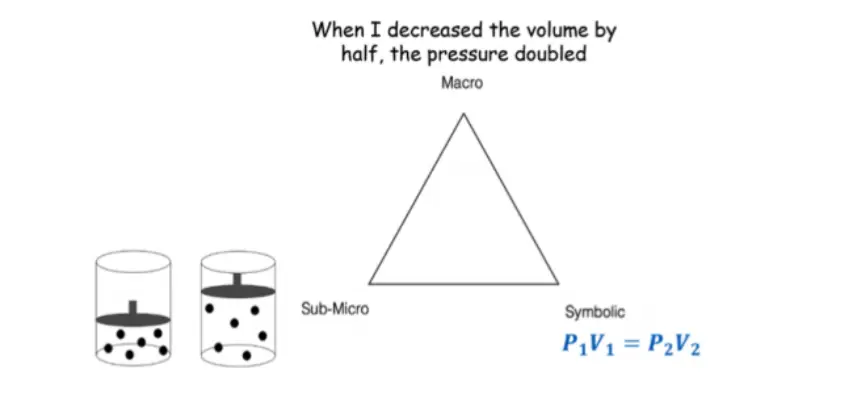
Image from ChemEdX
Practice
Symbolic
Watch the three video clips for examples of different representations of symbolic elements
Chemical Equations
Mathematical Representation
Graphical
Particulate (Sub-microscopic)
It should also be noted that the video under Chemical Equation on the previous slide shows a good example of a connection between the symbolic and particulate levels.
Macroscopic
Note, in this case the example is a “simulation” of what you would see. The key idea is that it is a phenomenon that you can in some way observe with your senses, most frequently sight, but it could also be touch (e.g., getting hot or cold).